

März 1976 – The Calling of Astrology in Esalen – = 50 Years in 2026
2006 – Cosmos and Psyche = 20 Years – https://cosmosandpsyche.com/
The Enigma Astrology in Academia – The Rosetta Stone for the Human Psyche
Kosmos Institute – https://www.kosmosinstitute.org
SAE Filmliste Prof. Dr. Richard Tarnas
https://www.youtube.com/playlist?list=PLlx8qA3u_BLGpt6eso0qtjrwpp1-jaGqQ
Copyright
Volker H. Schendel only has the right to publish the conversation uncut and unedited on freely accessible video platforms (i.e. no paywalls) and on his homepages. – Our Guest has the right to shorten, edit or add as he wishes and to publish it on his websites and video-platforms according to his liking
Talk – https://talk.vonabisw.de/Tarnas/RT.mp4
Youtube – https://www.youtube.com/watch?v=IuiYmAz5-Ls&t=5s
Bitchute – https://www.bitchute.com/video/nWjmElR1XtFX/
Rumble – https://rumble.com/v7e1bfo-enigma-astrology-in-society-with-prof.-r.-tarnas.html
Odysee – https://odysee.com/@BTGH:4/RT:67
The Enigma of Astrology – a deep mystery – a challenging anomaly for the modern mind – Astrology in the approach to life – a lighthearted conversation between Academia and practice in Astrology
*******
How should we understand the remarkable historical correspondences between planetary cycles and cultural transformations without falling into deterministic thinking?
How has your engagement with archetypal astrology changed your understanding of freedom, agency, and moral responsibility?
You have written extensively about archetypal cosmology. In what sense are archetypes ontologically real, and how does astrology illuminate their relationship to lived experience?
Would you argue that astrology reveals something about the structure of reality itself, or primarily about the structure of human consciousness?
If astrology is fundamentally symbolic rather than causal, what standards of intellectual rigor should govern its interpretation?
How can astrology avoid becoming merely a projection of psychological narratives while still honoring the symbolic richness of archetypal experience?
How do you distinguish meaningful synchronicity from confirmation bias without reducing either to purely subjective interpretation?
If astrology has survived for millennia across vastly different civilizations, what does that historical persistence itself tell us about human cognition and our relationship to the cosmos?
Is the current scientific paradigm capable of accommodating astrology, or would its serious consideration require a Kuhnian paradigm shift of comparable magnitude to the Copernican revolution?
*******
Richard Tarnas (born February 21, 1950, in Geneva, Switzerland) is an American cultural historian, philosopher, psychologist, and writer best known for his work on the history of Western thought, depth psychology, archetypal cosmology, and astrology. He is particularly associated with the idea that planetary cycles may correspond symbolically with patterns in individual and collective human experience.
Tarnas grew up in Detroit, Michigan, in a large family. He studied Greek, Latin, and the Classics at the University of Detroit Jesuit High School and Academy. He subsequently attended Harvard University, graduating cum laude with an A.B. in 1972. He received his Ph.D. from Saybrook Institute in 1976.
A major turning point in his intellectual life came when he went to Esalen Institute in Big Sur, California, in the 1970s. He spent roughly a decade there, studying and working in an environment strongly influenced by depth psychology, transpersonal psychology, philosophy, spirituality, and consciousness studies. He worked closely with figures such as Stanislav Grof and encountered thinkers including Joseph Campbell, Gregory Bateson, Huston Smith, and James Hillman. Tarnas eventually became Esalen’s director of programs and education.
His first major book was The Passion of the Western Mind, published in 1991. The book traces the development of Western thought from ancient Greece through Christianity, the Renaissance, the Scientific Revolution, the Enlightenment, Romanticism, and modernity. It became widely used as an introduction to the history of Western intellectual thought.
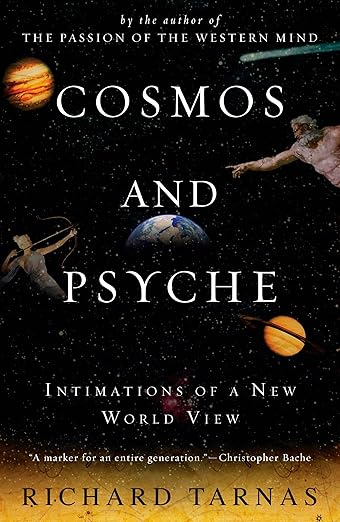
Tarnas’s second major book, Cosmos and Psyche: Intimations of a New World View (2006), marked a significant development of his ideas. Drawing on Jungian psychology, mythology, philosophy, cultural history, and astrology, he proposed what he calls archetypal cosmology. He argues that planetary cycles can be studied in relation to recurring patterns in human biography and history. The book received the Book of the Year Prize from the Scientific and Medical Network.
Tarnas also wrote Prometheus the Awakener, which focuses on Uranus and its proposed archetypal relationship with themes such as revolutionary change, innovation, liberation, and transformation. His broader work attempts to reconsider the relationship between psyche and cosmos, challenging the assumption that subjective human experience and the objective universe must be understood as completely separate domains.
For about 30 years, Tarnas taught at the California Institute of Integral Studies (CIIS) in San Francisco. He was the founding director of its Philosophy, Cosmology, and Consciousness program, teaching subjects including the history of ideas, depth psychology, archetypal cosmology, cultural history, and the evolution of consciousness. He is now Professor Emeritus.
He has also been involved with the International Transpersonal Association and served on the Board of Governors of the C. G. Jung Institute of San Francisco.
In short
Richard Tarnas’s career can be understood as a movement across several fields:
Classical studies → Western intellectual history → depth psychology → transpersonal psychology → consciousness studies → archetypal cosmology → astrology.
His central intellectual concern has been the relationship between human consciousness, historical development, psychological archetypes, and the cosmos. Rather than treating astrology simply as fortune-telling, Tarnas presents it as part of a broader philosophical inquiry into whether the universe might have a meaningful symbolic relationship with human experience.
His two most important books are The Passion of the Western Mind (1991) and Cosmos and Psyche (2006). Together, they provide the clearest overview of his intellectual development: the first explains how Western consciousness developed, while the second asks whether that consciousness may need to be reconnected with a more participatory and archetypal understanding of the cosmos.
*******
A Brief History of Western Thought – Filmliste – https://www.youtube.com/playlist?list=PLlx8qA3u_BLFthsP4uYvM_GsETahlPHAH https://talk.vonabisw.de/Tarnas/Mind1.mp4 – https://talk.vonabisw.de/Tarnas/Mind2.mp4 – https://talk.vonabisw.de/Tarnas/Mind3.mov.mp4 – https://talk.vonabisw.de/Tarnas/Mind4.mp4 – https://talk.vonabisw.de/Tarnas/Mind5.mp4
SAE Filmliste Prof. Dr. Richard Tarnas – https://www.youtube.com/playlist?list=PLlx8qA3u_BLGpt6eso0qtjrwpp1-jaGqQ – Spezial Richard Tarnas – https://www.youtube.com/playlist?list=PLlx8qA3u_BLHBOrkqcj-EkVvQ5kLKzi2v – Richard Tarnas on Cosmos and Psyche – https://www.youtube.com/watch?v=JTdwE_qVTE0&list=PLlx8qA3u_BLGpt6eso0qtjrwpp1-jaGqQ&index=3 – https://talk.vonabisw.de/Tarnas/13.mp4
https://astrology.vonabisw.de/prof-dr-richard-tarnas-ciis-free-will-in-astrology
12a – Prof.em. Richard Tarnas – Free Will in Astrology – https://www.youtube.com/watch?v=YEPZX0WkmM0 – Talk – https://talk.vonabisw.de/Wille/Richard1.mp4
12b – Prof.em. Richard Tarnas – Free Will in Astrology – Part 2 – https://www.youtube.com/watch?v=WxDe9r71l60 – Talk – https://talk.vonabisw.de/Wille/Richard2.mp4
Cosmos and Psyche: Intimations of a New World View
Homepage – https://cosmosandpsyche.com/about/
Astrowiki – https://www.astro.com/astrowiki/de/Richard_Tarnas
Playlist – https://www.youtube.com/playlist?list=PLCKPz4q3EX-uU6q39iI6UJQKYoqPF_8IQ
Archai – Homepage – http://www.archai.org
CIIS – http://www.ciis.edu/academics/pcc.html
Passion of the Western Mind – Understanding the Ideas That Have Shaped Our World View
Prometheus the Awakener –
*******
ASTRO-LEGEND RICHARD TARNAS – https://www.youtube.com/watch?v=brUkSVrUFGM&list=PLlx8qA3u_BLG3ZKLMQw9GK9aQYi8B5kXF&index=3 – https://talk.vonabisw.de/Tarnas/1.mp4
Richard Tarnas on Cosmos and Psyche – https://www.youtube.com/watch?v=JTdwE_qVTE0&list=PLlx8qA3u_BLGpt6eso0qtjrwpp1-jaGqQ&index=3&t=21s – https://talk.vonabisw.de/Tarnas/2.mp4
Richard Tarnas „The Second Axial Age“ – https://www.youtube.com/watch?v=VlukDizZ-Ac – https://talk.vonabisw.de/Tarnas/3.mp4
LEGENDARY ASTROLOGER REVEALS: Humanity Is Entering a Threshold of Transformation | Richard Tarnas – https://www.youtube.com/watch?v=IB6Pp1Ccjv8 – https://talk.vonabisw.de/Tarnas/4.mp4
Rick Tarnas: Exploring the Soul’s Journey through Time | Cosmic Codex Podcast – https://www.youtube.com/watch?v=_BpeG6iHoA0 – https://talk.vonabisw.de/Tarnas/5.mp4
Archetypes, Ancient Wisdom & Putting the Soul Back Into Psyche | Richard Tarnas – https://www.youtube.com/watch?v=oV0KYN6n6ng – https://talk.vonabisw.de/Tarnas/6.mp4
Re-Enchanting the Western World View with Richard Tarnas – https://www.youtube.com/watch?v=ZjdBcQGTgn0 – https://talk.vonabisw.de/Tarnas/7.mp4
Interview with Richard Tarnas: Navigating this Time of Crisis with Faith and Spiritual Awareness – https://www.youtube.com/watch?v=YQk1_goRWkE – https://talk.vonabisw.de/Tarnas/8.mp4
James Hillman’s Manifesto of Soul (RVP50) | Rick Tarnas | HITW 208 – https://www.youtube.com/watch?v=PtwnjHEYi8Q – https://talk.vonabisw.de/Tarnas/9.mp4
The truth behind astrology and the human mind — Richard Tarnas — Neon Galactic – https://www.youtube.com/watch?v=2HUWOx54z0s – https://talk.vonabisw.de/Tarnas/10.mp4
Richard Tarnas on the Planets in 2024: An Archetypal Astrology Overview I CIIS Public Programs – https://www.youtube.com/watch?v=yXUXRxH2V6A – https://talk.vonabisw.de/Tarnas/11.mp4
Richard Tarnas – On Depth Psychology, Spirituality, and the Human Journey. February 6th, 2025 – https://www.youtube.com/watch?v=upW6FTCR1z8 – https://talk.vonabisw.de/Tarnas/12.mp4
*******
- You have described astrology as an unresolved anomaly for the modern worldview. What, in your view, prevents contemporary academia from engaging with it as a legitimate philosophical question rather than dismissing it as a settled issue?
- Your work challenges the Cartesian separation between mind and cosmos. What kind of epistemology would be required for astrology to become intellectually conceivable within contemporary scholarship?
- Do you see astrology as evidence for an enchanted cosmos, or rather as an invitation to rethink the assumptions underlying modern scientific materialism?
- You have written extensively about archetypal cosmology. In what sense are archetypes ontologically real, and how does astrology illuminate their relationship to lived experience?
- How do you distinguish meaningful synchronicity from confirmation bias without reducing either to purely subjective interpretation?
- Could astrology be understood as a participatory mode of knowing rather than a predictive system? What would such a shift imply for philosophy of science?
- Do you believe the central challenge for astrology today is empirical validation, or is it primarily a crisis of interpretation and worldview?
- If astrology is fundamentally symbolic rather than causal, what standards of intellectual rigor should govern its interpretation?
- How can astrology avoid becoming merely a projection of psychological narratives while still honoring the symbolic richness of archetypal experience?
- Your intellectual journey bridges philosophy, psychology, history, and astrology. Which discipline, in your view, currently offers the greatest opportunity for a serious dialogue with astrology—and why?
- How should we understand the remarkable historical correspondences between planetary cycles and cultural transformations without falling into deterministic thinking?
- To what extent does astrology challenge the prevailing distinction between objective knowledge and subjective meaning?
- Would you argue that astrology reveals something about the structure of reality itself, or primarily about the structure of human consciousness?
- How has your engagement with archetypal astrology changed your understanding of freedom, agency, and moral responsibility?
- Many critics argue that astrology lacks falsifiability. Do you think falsifiability is an appropriate criterion for evaluating symbolic systems of knowledge?
- Is the current scientific paradigm capable of accommodating astrology, or would its serious consideration require a Kuhnian paradigm shift of comparable magnitude to the Copernican revolution?
- If astrology has survived for millennia across vastly different civilizations, what does that historical persistence itself tell us about human cognition and our relationship to the cosmos?
- How do you envision a productive collaboration between practicing astrologers and academic researchers without reducing one perspective to the assumptions of the other?
- What unanswered philosophical question about astrology do you consider the most important for the next generation of scholars?
- If you were designing a university curriculum for the study of astrology today, what intellectual traditions and methodological approaches would be essential?
- Looking back over your life’s work, what aspect of astrology do you believe remains most profoundly misunderstood—not only by skeptics, but also by astrologers themselves?