
facebook – https://www.facebook.com/darrel.rutkin
H. Darrel Rutkin is a Historian of Science specializing in the history of medieval, Renaissance and early modern astrology with a PhD from Indiana University. Recipient of prestigious pre- and post-doctoral fellowships—including a Rome Prize from the American Academy in Rome, Villa I Tatti, Harvard University’s Center for Italian Renaissance Studies in Florence, the Dibner Institute for the History of Science and Technology at M.I.T. and in its current incarnation at the Huntington Library, NYU’s Institute for the Study of the Ancient World and most recently at the Internationales Kolleg for Geisteswissenschaftliche Forschung (IKGF) at the Friedrich-Alexander Universität, Nürnberg-Erlangen.
*******
PhD Dissertation – Indiana University – „Astrology, Natural Philosophy and the History of Science, c. 1250–1700: Studies Toward an Interpretation of Giovanni Pico della Mirandola’s Disputationes adversus astrologiam divinatricem“ (2002).
*******
Università Ca‘ Foscari – Venezia
https://www.unive.it/data/search?q=Darrel+Rutkin#gsc.tab=0&gsc.q=Darrel%20Rutkin&gsc.page=1
*******
A COSMOLOGICAL CONTROVERSY IN THE RENAISSANCE: MARSILIO FICINO’S
AND GIOVANNI PICO DELLA MIRANDOLA’S CONTRASTING VIEWS
ON THE ANIMATION OF THE HEAVENS – https://iris.unive.it/retrieve/ea909804-ef9e-43b2-8c2d-d396927057ee/MyHOPOS.pdf – https://talk.vonabisw.de/Astrologen4/Darrel2.pdf
*******
Is Astrology a Type of Divination? – Thomas Aquinas, the Index of Prohibited Books, and the Construction of a Legitimate Astrology in the Middle Ages and the Renaissance1 – https://iris.unive.it/retrieve/e4239ddd-b9b6-7180-e053-3705fe0a3322/RutkinIsAstrology.pdf – https://talk.vonabisw.de/Astrologen4/Darrel3.pdf
*******
Optimus Malorum: Giovanni Pico della Mirandola’s Complex and Highly Interested Use of Ptolemy in the Disputationes adversus astrologiam divinatricem (1496), A Preliminary Survey – https://iris.unive.it/retrieve/e4239dde-971a-7180-e053-3705fe0a3322/RutkinPicoPAL2020.pdf – https://talk.vonabisw.de/Astrologen4/Darrel4.pdf
*******
Sapientia Astrologica: Astrology, Magic and Natural Knowledge, ca. 1250-1800: I. Medieval Structures (1250-1500): Conceptual, Institutional, … and Cultural (Archimedes, 55, Band 55)
https://scispace.com/pdf/sapientia-astrologica-astrology-magic-and-natural-knowledge-1ze3nt0m04.pdf – https://talk.vonabisw.de/Astrologen4/Darrel.pdf
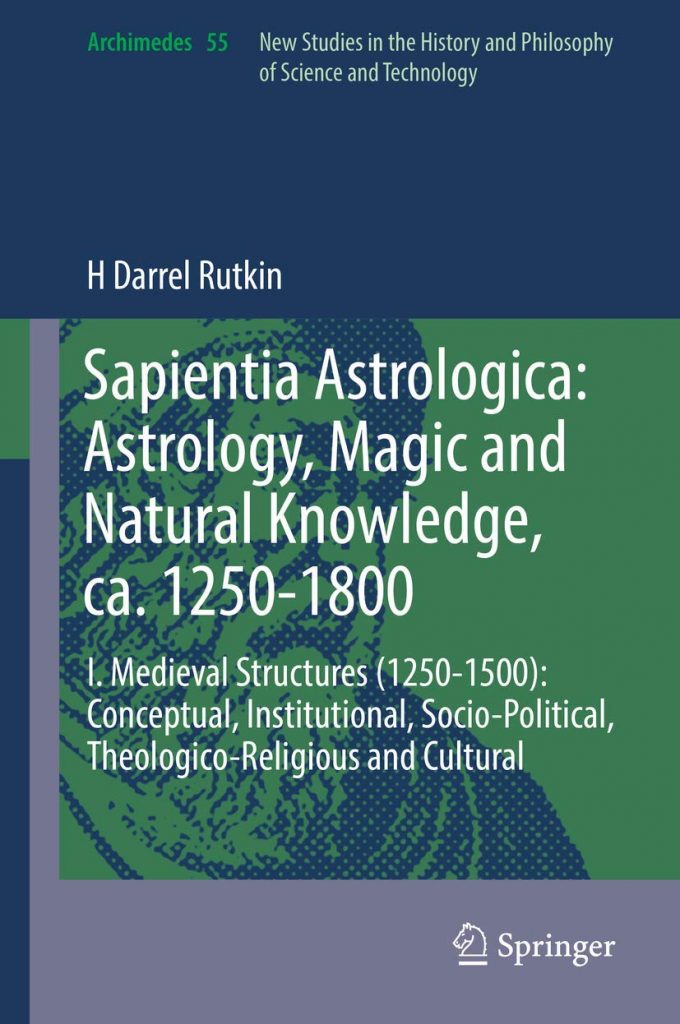
This book explores the changing perspective of astrology from the Middle Ages to the Early Modern Era. It introduces a framework for understanding both its former centrality and its later removal from legitimate knowledge and practice. The discussion reconstructs the changing roles of astrology in Western science, theology, and culture from 1250 to 1500.
The author considers both the how and the why. He analyzes and integrates a broad range of sources. This analysis shows that the history of astrology―in particular, the story of the protracted criticism and ultimate removal of astrology from the realm of legitimate knowledge and practice―is crucial for fully understanding the transition from premodern Aristotelian-Ptolemaic natural philosophy to modern Newtonian science.This removal, the author argues, was neither obvious nor unproblematic. Astrology was not some sort of magical nebulous hodge-podge of beliefs. Rather, astrology emerged in the 13th century as a richlymathematical system that served to integrate astronomy and natural philosophy, precisely the aim of the “New Science” of the 17th century. As such, it becomes a fundamentally important historical question to determine why this promising astrological synthesis was rejected in favor of a rather different mathematical natural philosophy―and one with a very different causal structure than Aristotle’s.
SAE – Filmliste Dr. phil. H. Darrel Rutkin – https://www.youtube.com/playlist?list=PLlx8qA3u_BLEePkWM3o32Wh8kpi5cgjiK
*******
Kontext
*******
Dr. phil. Benjamin Topp – Venenum de manibus credulorum extorquere: Giovanni Pico della Mirandola: Disputationes adversus astrologos I-IV. Edition, Übersetzung und Anmerkungen –
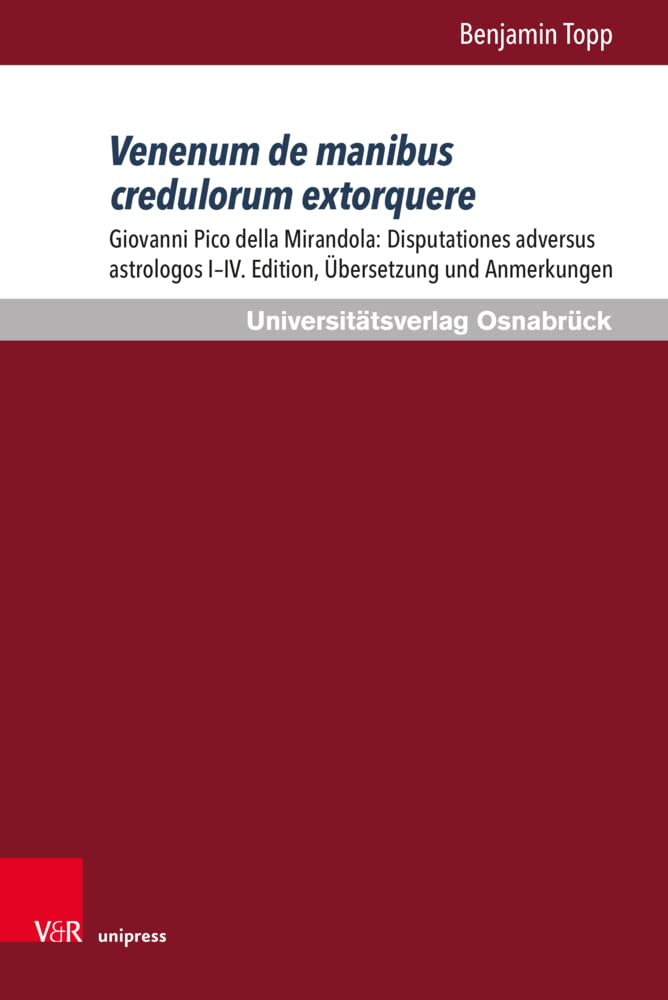
Die Disputationes adversus astrologos stellen allein hinsichtlich ihres Umfangs das Hauptwerk des Renaissancephilosophen Giovanni Pico della Mirandola dar. Ziel des Werkes, an dem der Autor in den letzten Monaten seines Lebens fieberhaft arbeitete und über dem er schließlich verstarb, ist die umfangreiche und vollkommene Widerlegung der Astrologie. Das vorliegende Buch stellt eine Edition der ersten vier Bücher, die sich mit den kosmologisch-naturwissenschaftlichen, philosophischen und theologischen Argumenten gegen die Astrologie beschäftigen, dar. Es enthält neben der eigentlichen Edition der ersten vier Bücher deren erste Übersetzung ins Deutsche, der zahlreiche Anmerkungen beigegeben sind. Die umfangreiche Einleitung beleuchtet Leben und Werk des Autors, den Inhalt der Disputationes sowie die komplexe Überlieferungsgeschichte des posthum erschienenen Werkes.
*******
David Juste, Benno van Dalen, Dag Nikolaus Hasse und Charles Burnett. – Ptolemy’s Science of the Stars in the Middle Ages (Ptolemaeus Arabus Et Latinus – Studies, 1) – https://www.brepolsonline.net/content/books/10.1484/M.PALS-EB.5.120189#chapters
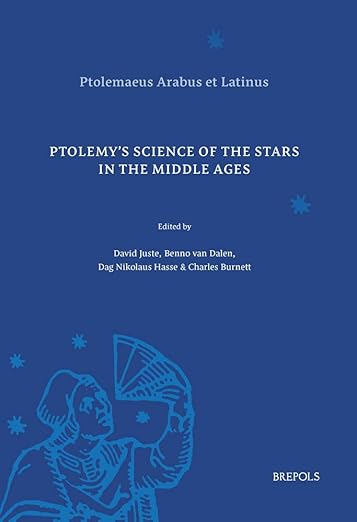
Claudius Ptolemy (c. 100-170 AD) is one of the most influential scholars of all time. While he is also the author of treatises on geography, optics and harmonics, his fame primarily stems from two works on the science of the stars, dealing with mathematical astronomy (the Almagest) and astrology (the Tetrabiblos). The Almagest and the Tetrabiblos remained the fundamental texts on the science of the stars for some 1500 years. Both were translated several times into Arabic and Latin and were heavily commented upon, glossed, discussed, and also criticised and improved upon, in the Islamic world and in Christian Europe. Yet, the reception of Ptolemy in medieval cultures is still to a large extent a terra incognita of the history of science. The Arabic and Latin versions of the Almagest and the Tetrabiblos are for the most part unavailable in modern editions, their manuscripts remain largely unexplored and, generally speaking, their history has never been systematically investigated. This volume gathers together fifteen contributions dealing with various aspects of the reception of Ptolemy’s astronomy and astrology in the Islamic world and in Christian Europe up to the seventeenth century. Contributions are by Jose Bellver, Jean-Patrice Boudet, Josep Casulleras, Bojidar Dimitrov, Dirk Grupe, Paul Hullmeine, Alexander Jones, Richard L. Kremer, Y. Tzvi Langermann, H. Darrel Rutkin, Michael H. Shank, Nathan Sidoli, Carlos Steel, Johannes Thomann and Henry Zepeda.
„Optimus Malorum: Giovanni Pico della Mirandola’s Complex and Highly Interested Use of Ptolemy in the Disputationes adversus astrologiam divinatricem (1496): A Preliminary Survey“.
Rutkin untersucht darin die komplizierte Beziehung von Giovanni Pico della Mirandola zu Ptolemäus. Interessant ist, dass Pico die Astrologie scharf angriff, gleichzeitig aber Ptolemäus selektiv benutzte – mal als Autorität gegen astrologische Praktiken, mal zur Unterstützung eigener Argumente. Der Beitrag zeigt, dass die Geschichte der Astrologie in der Renaissance nicht einfach eine Geschichte von „Glauben vs. Ablehnung“ war, sondern eher ein komplexer Umgang mit wissenschaftlicher Autorität.
*******
Prof. Dr. Wouter J. Hanegraaff
Filmliste – https://www.youtube.com/playlist?list=PLCKPz4q3EX-seD7xl957pRvZ6ZF1xJlHs
*******
Debating the Stars – Pico Della Mirandola Against Astrology – https://www.youtube.com/watch?v=Gb9TCcdxNpM – https://talk.vonabisw.de/Astrologen4/Darrel5.mp4
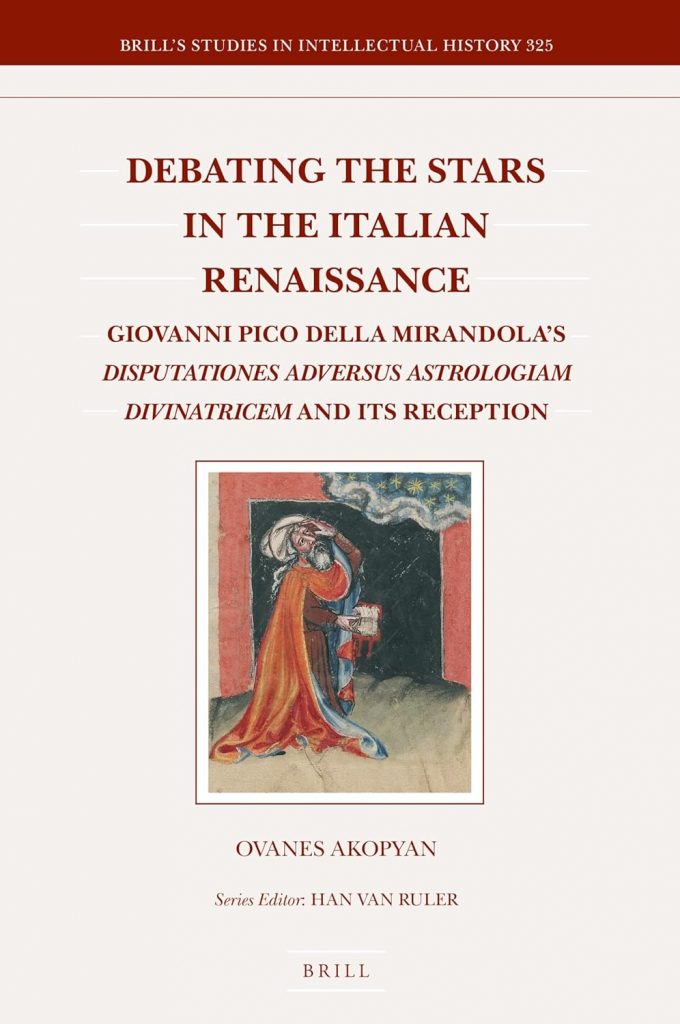
Debating the Stars in the Italian Renaissance: Giovanni Pico della Mirandola’s Disputationes adversus astrologiam divinatricem and Its Reception (Brill’s Studies in Intellectual History, 325)